
Osborne County VINELink Coverage
Kansas VINELink is a custody-information and notification service available around the clock. It is a person-level check, not an Osborne County release list, court docket, or complete history. Coverage depends on the agency that sends the record. No official Osborne County page confirms a special county VINE program or guarantees that every Osborne County Jail booking appears. Search the live service and require the result to name the right reporting agency or facility.
A county result can serve as a status clue when the contributing agency reports custody or a change. A Kansas state-prison result must be compared with the Kansas Adult Supervised Population Electronic Repository, known as KASPER. VINELink does not replace the Federal Bureau of Prisons locator, immigration locator, or a court record. Each source reports on its own custody system.
| Custody path | Correct check | What confirms the event |
|---|---|---|
| Osborne County Jail | Test Kansas VINELink, then call the Sheriff | Sheriff release or transfer entry |
| Kansas prison or supervision | VINELink plus KASPER | KDOC status, movement, sentence, or discharge record |
| Federal BOP custody | BOP Inmate Locator | BOP record or responsible federal agency |
| Immigration custody | ICE detainee locator | ICE custody information or responsive record |
Note: Absence from VINELink is only a search result, not proof of release, transfer, discharge, or mistaken identity.
Search One Osborne County Inmate
Use the modern Kansas state route and search only for the specific person of concern. A legacy Kansas route also resolves through VINELink Classic, but the modern state page is the clearer starting point. Gather a full name, known spelling variants, and an offender or booking number if one is available. Those details reduce the risk of opening the wrong person’s record.
- Open Kansas VINELink and select the People or Person search.
- Enter the family name and given name. Use an offender or booking identifier when the interface accepts one and the number is known.
- Review all possible matches. Compare the reporting agency or facility and every available identity detail before selecting a record.
- Open the custody details. Record the exact displayed status, agency, identifier, and event date rather than paraphrasing them.
- If the result says released or out of custody, call the reporting custodian or request its record for the actual date, time, reason, and destination.
- If Osborne County is absent or no reliable match exists, use the Sheriff and district-court channels. Do not turn “no result” into a release claim.
For local custody, call Osborne County Sheriff and Dispatch at 785-346-2001. Ask whether the named person remains held and, if not, whether staff can confirm departure or direct a narrow Kansas Open Records Act request. The Osborne County District Court record may explain bond, dismissal, sentence, probation, or another legal order. It does not supply the jail’s actual exit time.
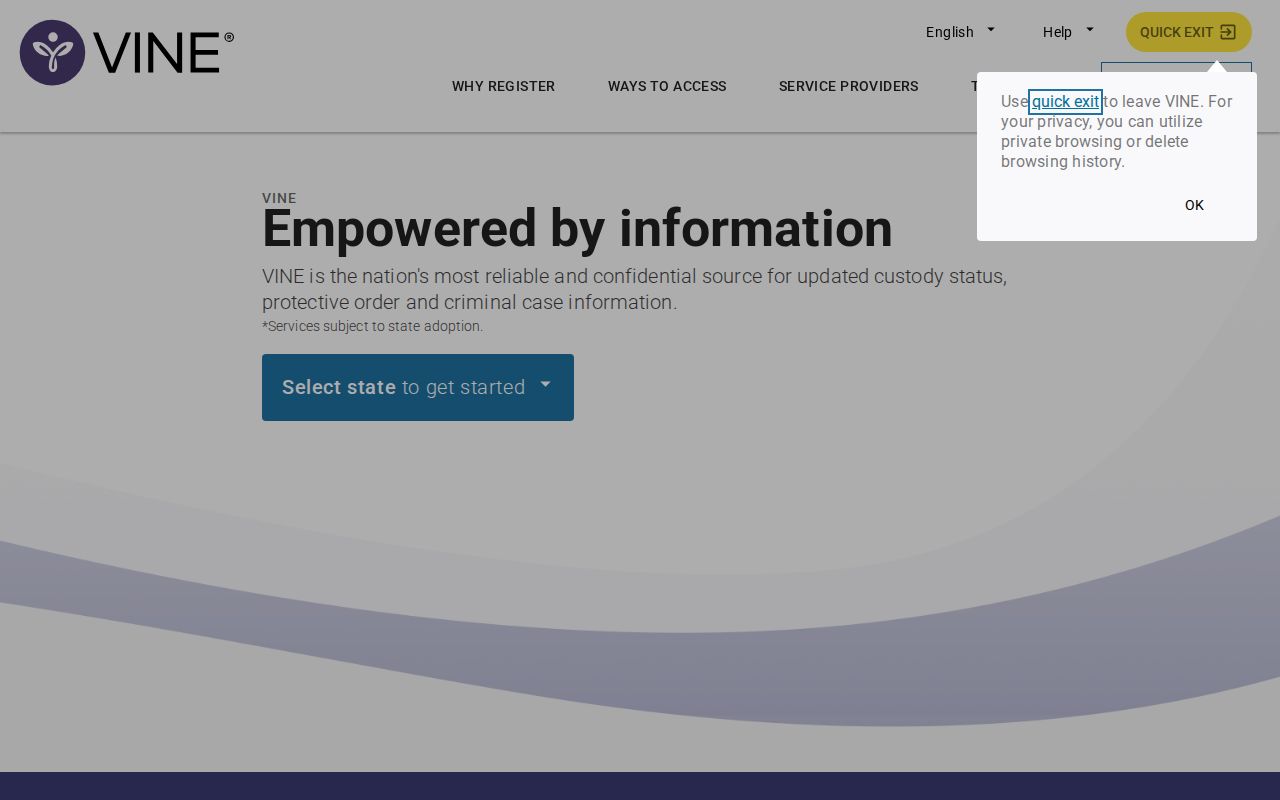
The official VINELink search entry shows the state selection and person-search route.
Osborne VINELink Release Fields
The live record controls what is available. A result commonly provides a custody label and reporting agency. It may also provide an identifier, location, or event date. Do not promise an exact exit time, release reason, destination, photograph, sentence discharge, or receiving agency unless that field actually appears. A VINE event reflects the source agency’s feed, not a universal record shared across every custodian.
| Displayed item | How to read it |
|---|---|
| Person name | A match clue that still requires other identifiers |
| Custody status | The contributing agency’s current label, such as in custody or released |
| Reporting agency | The custodian responsible for the data and follow-up |
| Identifier | An offender or booking reference used to separate similar names |
| Event date or location | A feed detail whose exact meaning must be read in context |
A released or inactive label is a useful clue, but it does not prove community return. A person may have transferred to KDOC, another jail, a federal authority, or immigration custody. Ask the source custodian for the disposition and receiving agency. For a Kansas prison case, the KASPER current status and movement fields provide the stronger state-corrections check.
Register Osborne Release Notifications
Registration must attach to the correct live person record. Available controls and delivery methods can change, so follow the labels shown by the interface. Choose the event that matters, especially release or custody change. Notifications can also cover transfer, escape, return to custody, or another reported event when the agency offers those options.
- Open the verified matching record and select “Register,” “Get Notifications,” or the equivalent control.
- Choose the release, transfer, or custody-change event offered for that record.
- Select an available delivery route, which may include telephone, text, email, or an in-app or account notice.
- Enter the phone number, email address, or account information accurately.
- Complete the confirmation required for that channel. Classic automated telephone enrollment asks for a four-digit PIN, which is entered when an alert call arrives to confirm receipt.
- Save the enrollment confirmation and keep contact information current. Do not publish the PIN.
- When an alert arrives, reopen the person record and verify the event with the contributing agency.
Email, text, and account flows use the verification shown in the interface. They should not be assumed to use the phone PIN. An alert is a prompt to check the source, not a complete release document. If a call or message conflicts with the live status, note the time of both and contact the agency that supplied the record.
- Custody alert
- An automated notice that a contributing agency reported a selected event.
- Transfer
- Movement to another custodian, not release into the community.
- Discharge
- The end of a sentence obligation, which a simple jail-release alert does not establish.
- Reporting agency
- The office or facility that contributes the status and should confirm its meaning.
Does Osborne Have County VINE?
No official Osborne County page establishes a separate county VINE layer, guarantees jail participation, or describes a county enrollment program. That is the distinctive local limit. The correct method is to test the exact person and agency in Kansas VINELink. If the Sheriff does not appear, or the record cannot be tied to the right person, use direct and court channels rather than assuming the person was released.
The Sheriff’s official site is an informational contact page and does not publish an inmate roster or recent-release interface. The Osborne County open-records page directs requests to the office that holds the record. Its official request form can support a narrow request for the existing booking/release entry, actual departure date and time, disposition, and receiving agency, subject to lawful disclosure. That record is stronger than an automated absence.
Note: Osborne participation is a live-record question, so test VINELink again when timing matters and retain the lookup date.
KDOC Alerts for Osborne Cases
KDOC operates separate victim services and a notification program. KDOC states that the offender must be in a KDOC facility or under KDOC supervision for that registration. This path may fit an Osborne County case after a person enters Kansas correctional custody, but it is not a substitute for county VINE when the only custody was an Osborne County Jail booking.
KASPER should also be checked for a state case. It covers people sentenced to the Secretary of Corrections since 1980 who are incarcerated, supervised after incarceration, or discharged. Status terms matter. Parole, conditional release, and postrelease supervision indicate that a person can be outside prison while still supervised. “Discharged” supports that the KDOC sentence obligation ended.
Confirm Osborne VINELink Results
VINELink can lag the source agency, and its record may not include the facts needed to explain a departure. For an Osborne booking, call the Sheriff and seek the release or transfer entry. For state custody, compare KASPER and contact KDOC. For federal BOP custody, use the federal locator. If immigration custody is possible, use ICE’s locator. The Osborne County release-record path can help reconcile a local custody event with a court order.
Identity remains the first control. Use the full legal name, aliases, date of birth where appropriate, agency identifier, and case number. Record which system was checked, the time of the lookup, the displayed wording, and the reporting agency. If two official sources conflict, preserve both results and request the underlying record instead of choosing the more convenient answer.
A current-custody result shows where the source says the person is held. A release alert shows a reported change. A source custodian’s entry documents the actual custody event. A court or PRB order is the legal event. Keeping those levels separate prevents a VINELink clue from being overstated.
Save an enrollment confirmation and keep the chosen phone number or email current. When a notice arrives, reopen the matching record before acting on it. A classic telephone alert may ask for the four-digit PIN created at registration, while text, email, and account notices use the confirmation method shown in the current interface. Do not assume every channel uses the telephone PIN. If the event wording is unclear, give the reporting agency the displayed identifier and ask what its status and date mean.