
Osborne Projected and Actual Release
Kansas Department of Corrections uses the official term Anticipated release date. That field serves the projected-date question for a person in KDOC scope, but it is not the same as an actual release. It reflects the sentence computation and information available at the time. Actual release is a completed movement out of the named custody. Discharge is different again: it means the sentence or supervision obligation has ended.
An Osborne County Jail detainee awaiting trial ordinarily has no KDOC anticipated date. Release may depend on posting bond, a dismissal, a judge’s order, resolution of holds, or another legal event. Even when a court orders release, jail staff must complete processing and determine whether another custodian has a detainer. A short local sentence also requires the Sheriff or court calculation unless the person enters KDOC custody.
| Date or event | What it answers |
|---|---|
| KDOC anticipated release date | The current state sentence-computation estimate |
| Parole eligibility date | The earliest legal eligibility for an applicable parole process, not a grant |
| Court order date | When the judge acted, not necessarily when jail processing ended |
| Actual exit date and time | When the named custodian recorded departure |
| Discharge date | When the sentence or supervision obligation ended |
Find an Osborne Release Date
Start with custody type. KASPER covers people sentenced to the Kansas Secretary of Corrections since 1980 who are incarcerated, supervised after incarceration, or discharged. It does not include every Osborne jail detainee or every Kansas case. The Sheriff and court are therefore central for local custody. Federal and immigration custody require their own systems.
- Identify whether the person is in Osborne County Jail, a KDOC facility, federal BOP custody, immigration custody, or another jail.
- For KDOC, open the KASPER disclaimer and search. Use the KDOC number when known, or search by name with optional identity filters.
- Open only a record whose birth data, photograph, physical details, KDOC number, conviction, and case information fit. “Osborne” as conviction county does not show present residence.
- Read current status first. Then inspect sentence, movement, supervision, and the officially labeled Anticipated release date.
- For Osborne County Jail, call 785-346-2001 and review the Osborne County District Court case for bond, sentence, jail credit, holds, and orders.
- If the date or computation needs formal confirmation, contact KDOC Sentence Computation at 785-296-3317 or request the underlying public record.
The KASPER search allows name, alias, KDOC number, KBI number, race, gender, birthdate or age, conviction county, and supervision county filters. Identity comes before dates. Two people can share a name, and an old image can be misleading. KDOC also warns that the image-recorded date may differ from the day the photograph was taken.
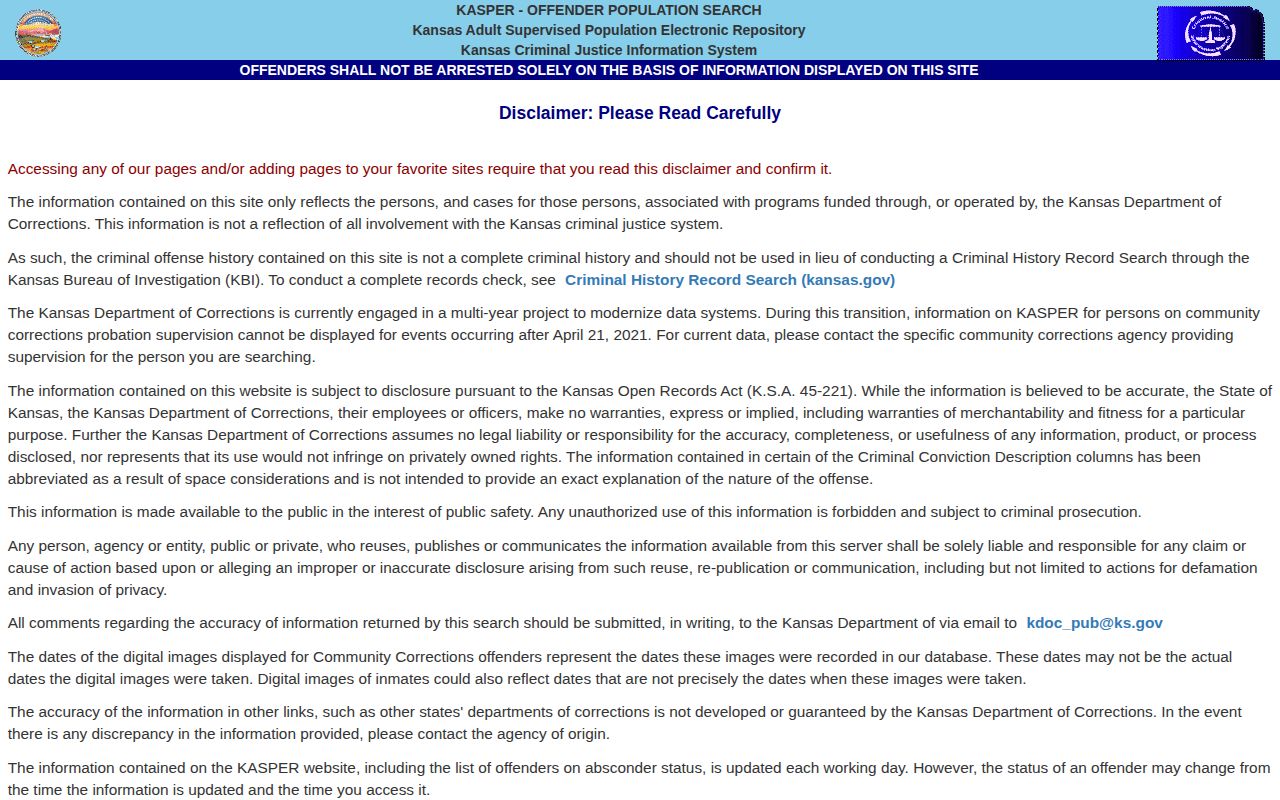
The official KASPER entry and disclaimer explains the repository’s scope before a search begins.
Note: KASPER updates on working days, so a completed release can occur before the public status visibly changes.
Kansas Credits Affect Osborne Dates
For Kansas guidelines crimes committed on or after July 1, 1993, K.S.A. 21-6821 authorizes KDOC good-time rules and forfeiture. The maximum reduction is generally 15 percent of the prison portion. That is the basis of the common “serve 85 percent” shorthand. It is not a promise that every Kansas prisoner serves exactly that share. Credits must be earned and retained, and some sentences are governed by other limits.
Qualifying nondrug severity levels 7 through 10 committed on or after January 1, 2008, along with specified lower drug-severity cases, may receive up to a 20 percent reduction. That can produce 80 percent service in a qualifying case. The statute also permits up to 120 days of program credit for successful completion of designated programs in eligible cases. Severity, offense, aggregation, and other exclusions control whether that credit applies.
Specified sexually violent, sexually motivated, and enumerated sexual offenses are treated differently. Good-time reduction, and applicable program credit, may be added to postrelease supervision. Program credit generally is not added to supervision in other cases. K.S.A. 21-6806 confirms that imprisonment terms are actual time subject to lawful good-time reduction.
Older pre-guidelines indeterminate sentences follow another framework. K.S.A. 22-3725 contains a good-time table for covered crimes committed before July 1, 1993. KDOC explains that a minimum term of two years or more may reach parole eligibility at half the minimum if all credits are earned, while a one-year minimum may reach eligibility at nine months. Conditional release is commonly tied to half the maximum when credits are not lost. The statute and the individual computation control.
- Good time
- Credit earned and retained under the rules that can reduce the prison portion of an eligible sentence.
- Program credit
- A separate potential reduction for successful completion of designated programs in qualifying cases.
- Determinate sentence
- A fixed guidelines term that generally leads to mandatory postrelease supervision after prison.
- Indeterminate sentence
- An older minimum-to-maximum sentence that may involve discretionary parole eligibility.
Sentence Limits on Osborne Dates
K.S.A. 22-3717 sets parole eligibility and mandatory-period rules. Life without parole and specified murder, off-grid, class A, Hard 50, and other named sentences have exclusions or mandatory terms that the simple 15 percent shorthand cannot cut. A reader should not subtract a percentage from the pronounced sentence and announce an exact day.
Post-July 1, 1993 determinate grid sentences generally are not parole-eligible. After the prison portion, the person usually enters mandatory postrelease supervision. The Prisoner Review Board sets conditions but does not grant an earlier discretionary parole date for the ordinary determinate case. Older indeterminate cases may require a Board hearing and decision. A potential release month on the prospective hearing list is not a parole grant.
For a local jail sentence, the research found no official Osborne County policy for jail good time, weekend release, release hours, or local sentence computation. Those gaps must not be filled with another county’s practice. Ask the Osborne County Sheriff and court for the calculation and existing record. If the record is not available through a direct inquiry, use the county open-record process and its request form. The absence of a published local rule is not proof that no internal calculation exists.
Why Osborne Release Dates Change
An anticipated date can move when the inputs to sentence computation change. Some changes affect the sentence itself, while others affect whether the person can return to the community on that date. KASPER display timing adds a separate issue because the public repository updates each working day and excludes weekends.
| Factor | Possible effect | Best confirmation |
|---|---|---|
| Good time earned or forfeited | Moves the prison portion within the governing credit rules | KDOC Sentence Computation |
| Program eligibility or completion | May add lawful program credit in a qualifying case | KDOC computation record |
| Disciplinary action | May cause forfeiture under applicable rules | KDOC discipline and computation records |
| Jail credit or amended court order | Changes a sentence input | Court journal entry and KDOC calculation |
| Consecutive sentences or aggregation | Changes the combined term and date | Sentencing records and KDOC |
| Detainer or agency hold | May prevent community return even when one sentence reaches its date | Custody movement and receiving-agency record |
| PRB action | Affects an eligible indeterminate parole case | PRB decision and later KASPER status |
A transfer is not community release. If an Osborne custody record names KDOC, another jail, USMS, BOP, ICE, or another receiving agency, search that system. A person can leave one facility on the expected date yet remain in government custody elsewhere. The destination field resolves that common ambiguity.
Note: A detainer can change where a person goes without changing the fact that the first custodian recorded a departure.
Osborne Parole Dates Need Decisions
The Kansas Department of Corrections Prisoner Review Board handles parole for eligible indeterminate sentences. Its public-comment calendar is prospective. A listed hearing month and potential release month show an upcoming process, not a favorable result. Under Kansas law, a parole grant cannot produce release before the eligibility date.
Board terms must be read closely. “Parole” is a grant subject to the lawful date and conditions. “Continue” leaves the matter pending for deliberation, more information, evaluation, or votes. “Pass” denies parole and sets a later hearing under the applicable timing. No public person-level PRB decisions archive was found. Confirm an outcome through KASPER, KDOC/PRB contact, or a record request for the public decision.
The distinction matters for Osborne County because many determinate cases do not use a discretionary grant at all. First identify sentence type. Then use the correct date path instead of sending every “when do they get out” question to the hearing calendar.
Confirm an Osborne Actual Release
For a KDOC prisoner, read current status and movement after the anticipated date, then contact KDOC if timing matters. “Parole,” “conditional release,” or “postrelease supervision” means the person may be outside prison but remains supervised. “Discharged” supports that the state sentence obligation ended. Neither term should be replaced with a generic “released” label.
For Osborne County Jail, call the Sheriff, then request the release or transfer entry if documentary proof is needed. Pair it with the district-court order that explains the legal basis. The order date may precede physical processing, and another hold may redirect the person. The Osborne County release search and records process gives the full local reconciliation path.
VINELink can provide a pending custody-change alert if the correct agency and person appear, but its data may lag. Registration and alert confirmation are covered in the Osborne VINELink inmate search. When an alert arrives, reopen the record and verify with the source agency rather than treating the message as the final release document.
The official KDOC locating FAQ defines the anticipated-date field and warns that release information can change.

A sound conclusion records three things: the anticipated date and lookup time, the actual custody movement, and any discharge or supervision status. If official sources conflict, preserve each result and ask for the underlying computation or movement record. Do not calculate the answer from sentence length alone.