
Osborne Parole and Probation Compared
Parole and probation can both place a person in the community under rules, yet the legal source is not the same. Kansas parole applies to an eligible prison sentence when the Kansas Department of Corrections Prisoner Review Board grants supervised release. Determinate guidelines sentences generally move to mandatory postrelease supervision after the prison part instead of receiving a discretionary parole grant. Conditional release is another KDOC status tied to the sentence framework. Probation begins with an Osborne County court order and is not proof that the person first served a KDOC prison term.
| Point | Parole or postrelease | Probation |
|---|---|---|
| Source of authority | KDOC sentence and, for eligible parole cases, Prisoner Review Board action | District court order |
| Best first record | KASPER status, movement, and supervision fields | Osborne court docket, judgment, and probation order |
| Office clue | Current parole-office location shown by KASPER or supplied by KDOC | Community-corrections agency identified in the court record |
| End of status | KASPER “Discharged” or a PRB/KDOC discharge document | Court discharge, termination, or other closing order |
Do not read “released” as “free of all obligations.” A person on parole, conditional release, or postrelease supervision has left a prison but remains within KDOC supervision. By contrast, “Discharged” supports that the KDOC sentence obligation ended. A probation case requires its own court record because KASPER does not provide a complete, current account of all community-corrections activity.
- Parole
- Supervised release granted by the Prisoner Review Board for an eligible indeterminate sentence.
- Probation
- A court-ordered community sentence administered through the supervision route named by the court.
- Postrelease supervision
- Mandatory supervision that follows the prison part of many determinate Kansas sentences.
- Discharge
- The documented end of a sentence or supervision obligation.
Verify Osborne Post-Release Supervision
Begin with the last known legal custodian, not a broad name search. The official KASPER search covers people sentenced to the Kansas Secretary of Corrections since 1980 who are incarcerated, supervised after prison, or discharged. It does not index every stay in Osborne County Jail. The Osborne court trail supplies probation authority, while the Sheriff custody record confirms a local release or transfer.
- Search KASPER by KDOC number when known, or use the full name and other available identifiers. Open only a record whose date of birth, description, photograph, case, and county details fit.
- Read the current status before relying on a date. Parole, conditional release, postrelease supervision, compact supervision, incarceration, and discharged status mean different things.
- Use the displayed parole-office field as the current routing clue. KDOC assignments can change, so do not rely on an old regional-office list.
- For probation, review the Osborne County District Court docket and order. Identify the supervision agency named by the court.
- Check an official absconder search only when that issue matters. Treat a match as a reported status, not as proof of a new conviction or discharge.
- Confirm the end of supervision through “Discharged,” a court order, or an appropriate PRB/KDOC certificate. Save the source, status, and lookup time.
KASPER has a specific community-corrections limit. KDOC states that community-corrections events after April 21, 2021 cannot currently display because of modernization issues. The named community-corrections agency must therefore confirm newer probation activity. For the full release trail, the Osborne County released-inmate search and records path explains how the Sheriff custody entry and court order answer separate parts of the event.
Note: “Osborne” as a conviction county does not prove that the person now lives in Osborne County or reports there.
Osborne Supervision Office Routing
No current official source verified a fixed local parole-office assignment for Osborne County. Older official material connected Osborne with Northwest Kansas Community Corrections, but office assignments can change and the current KDOC table was not reliably available during research. Publishing an old office as the present reporting site could send a reader to the wrong place. Use KASPER’s supervision-office field or contact KDOC for current routing. For probation, use the agency named in the active district-court order.
KDOC Prisoner Review Board
714 S.W. Jackson Street, Suite 300
Topeka, KS 66603
Phone: 785-746-7516
Email: KDOC_PRB_Public_Comment@ks.gov
The Board contact is suitable for its parole process and public-comment work. It is not a substitute for the current supervising officer. The Parole Services Automated Reporting System number is also not a general public status line; it is for people directed to use automated reporting. A public requester who needs a decision document can use the KDOC record-request route after checking public KASPER data.
Probation records remain with the court and the supervision provider. The local court record may show the judgment, probation term, later modification, revocation, or discharge. A docket entry is a legal event. It does not establish the exact minute someone physically left Osborne County Jail, so reconcile it with the Osborne County Sheriff when the custody event matters. If a public supervision or discharge record is not online, follow the county open-record process and submit the official request form to the office that holds it.
Osborne Parole Hearing Records
The current decision-maker is the three-member Kansas Department of Corrections Prisoner Review Board, not a separate Kansas Parole Board. Its public-comment schedule lists monthly sessions held one month before an offender’s parole hearing. The prospective listed-offenders page may show commitment name, KDOC number, county of offense, case number, offense code, hearing month, and potential release month.
A listing with “county of offense: Osborne” is not a release result. It does not show that parole was granted, that the person will return to Osborne County, or that the listed potential month became an actual exit date. Kansas law requires the hearing before eligibility, and a grant cannot cause release before the lawful eligibility date. The Board weighs the governing sentence, institutional conduct, program work, risk information, official and public input, facility recommendations, and other factors in its process.
The key outcomes are parole, continue, and pass. Parole means the Board found the eligible person suitable, subject to the legal date and conditions. Continue means the matter remains pending for more information, evaluation, deliberation, or votes. Pass means parole was denied and a later hearing will be set under the applicable rules. No public person-level results archive was found. Verify the result through later KASPER status, KDOC/PRB contact, or a request for the public decision or order.
The official Prisoner Review Board process defines its decision terms and parole role.

Osborne Supervision and Absconder Status
Conditions differ by sentence and order. At a high level, the supervising authority may set reporting, location, conduct, or other lawful conditions. The public correctional categories can include non-treatment conditions and supervision violations, but protected treatment, medical, and psychiatric records may be withheld. A public search should be used to verify the exact status and route a record request, not to guess at private details.
The KDOC parole absconder search is distinct from a routine KASPER profile. An absconder is a person reported as having stopped complying with required supervision or whose whereabouts are not known to the agency. That label does not mean the sentence ended. It is also not independent authority for a member of the public to detain or confront anyone. Contact the responsible agency if the official record needs clarification.
The official KDOC parole absconder portal shows its filters and cautionary notice.
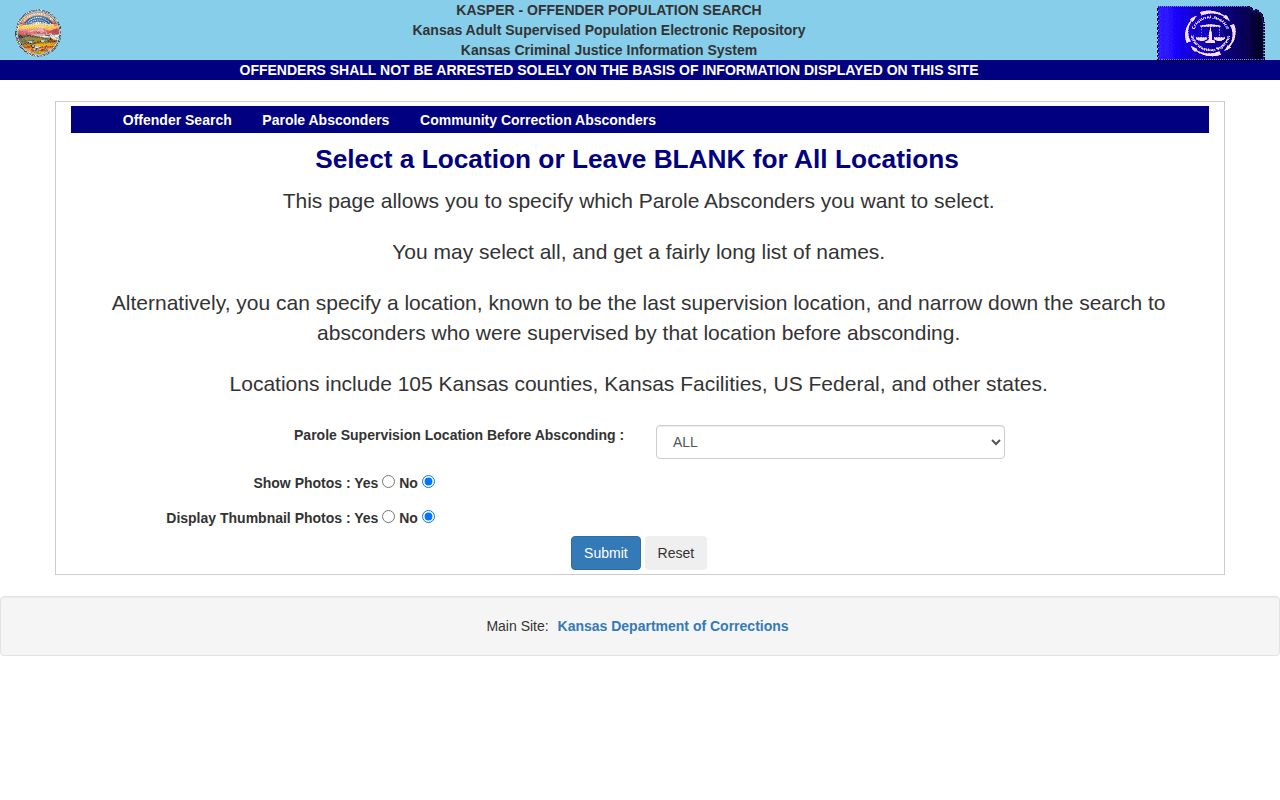
Note: A reported violation, warrant, or absconder status is not the same as a conviction, revocation order, or sentence discharge.
Osborne Parole and Probation Discharge
Supervision ends through the authority that created it. For parole, conditional release, or postrelease supervision, look for KASPER “Discharged” and obtain an appropriate KDOC or PRB document when formal proof is needed. The PRB may discharge successful parole or conditional-release cases, and a maximum-sentence discharge certificate records satisfaction of the sentence at its maximum date. A release from prison is earlier and different: the person can be in the community while still supervised.
Probation ends through a district-court event. Review the Osborne case for a discharge, termination, successful completion, revocation, or other final order. Do not infer completion because a name is missing from KASPER, since ordinary county probation is not the same data set and newer community-corrections events have the stated display gap. If public records conflict, record each source and lookup date, then ask the court or KDOC for the underlying order.